| Introduction |
| |
| This presentation
on the Enneagram offers a new way of looking at the everyday world and
approaching improvements.
The first step is to find out
who you are and where you belong in the Enneagram system. Then a more
effective way of living and working becomes possible.
Human systems need a balance of
different types of people with different skills and talents and ways of
relating. The Enneagram can help organizations realize the
valuable asset they gain by having people who look at the same situation
in quite different, sometimes opposing ways. There is a tolerant
inherent in the understanding that who we are determines what we see. This
valuable knowledge supports effective teamwork and enhanced
productivity.
|
| Value
of the Enneagram |
| |
The
Enneagram provides a sense of who you are, how you fit into the scheme
of things, and how you interact with other people. It helps you
understand other people and their points of view.
The Enneagram helps you understand how you are boxed in by your habit of
mind so that you have a chance to get out of your particular box.
It works in team building. It promotes effective relationships,
successful adaptation to change, understanding the strengths and
weaknesses of yourself and others, and avoidance of blame. It
helps you to take things less personally when you are under stress.
By learning to recognize the fundamental differences among us,
relationships with spouses, family, friends, and business associates
will improve. Improved interactions will enhance effectiveness and
efficiency.
|
| Basics |
| |
The Enneagram is a system of personality development with ancient roots, based on what we can observe about how people think, feel, and behave.
The word Enneagram comes from the Greek. 'Ennea' means
nine and 'gram' means something written or drawn. The Enneagram is a nine-pointed figure drawn to represent the nine types of people.
As a result our inherited nature and our childhood experiences, each of us developed a limited view of the world to help us survive and cope. This becomes our world view or our personality type.
This approach to the system is built on self-discovery and self-observation. People see the world very differently from each other.
The Enneagram recognizes three different and equally-important kinds of
intelligence:
 | an intelligence of the heart or emotions, types 2,3,4 |
| an intelligence of the mind, types 5,6,7 |
| and intelligence of the body, its energy,
kinesthetic, and sensation, types 8,9,1 |
The
Enneagram reflects how the mind is organized, its pattern of attention ,
and the habits of mind.
In
the same way that no one can assign you an Enneagram number, it is
important for you to avoid trying to assign an Enneagram number to
colleagues and friends. This respects each individual's process of
self discovery and self understanding.
|
| Definitions
Used in Describing Each of the Nine Types |
| |
| The
Lost Essential Quality is the quality whose loss in childhood
influenced our development. |
| |
| The
Compensating Belief is what we substitute for the lost
quality. |
| |
| The
Attention/Coping Strategy is what we used to survive. |
| |
| The
Trap is what we mistakenly believe will bring security and
satisfaction. |
| |
| The
Driving Energy is the force that fuels the world view of each
of the nine personality types. |
| |
| The
Avoidance is the thing each of us dreads. |
| |
| The
Strengths are the benefits or positive attributes resulting
from our attention/coping strategy. |
| |
| The
Paradox is when the strategy produces the opposite result of
what we really want. |
| |
| The
Path of Development is what each type has to do to overcome
the pitfalls and maximize the gifts of his or her personality. |
| |
| Enneagram
Personality Types |
| |
|
|
|
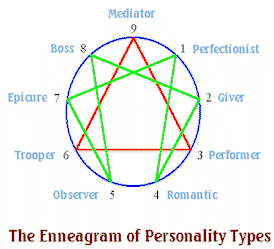
The inner triangle of Three, Six and Nine represents the three major energy centers.
Type Three is the center of the Heart, or Image, triad consisting of type Two, Three and Four. The energy of these types focuses on issues of feelings and emotions and on how one's image is perceived by others.
Type Six is at the core of the Head, or Mental, triad of Five,
Six and Seven. These types form their personalities around
mental functions and imagination, and focus on issues of fear.
Type Nine, the center of the Body triad, and
Types Eight and One focus on sensing the world through the body, tend
to be self-forgetting and have issues of power and anger.
|
|